2026-27 Federal Budget
12
May
2026
4
min read
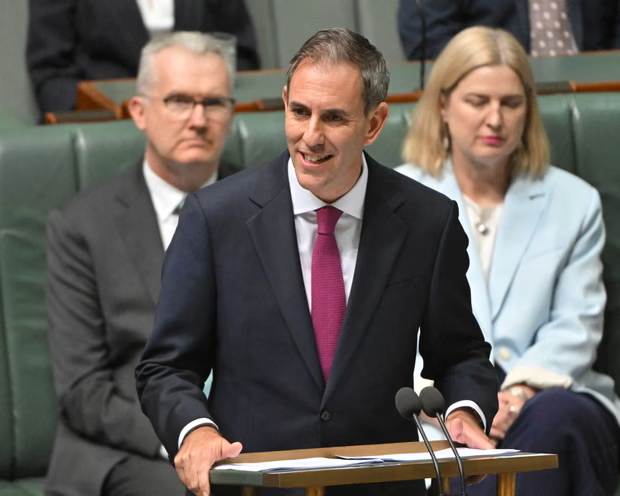
On 12 May 2026, Treasurer the Hon. Dr Jim Chalmers handed down the 2026-27 Federal Budget which he says is "the most important and ambitious Budget in decades".
Overview and Analysis
The Treasurer says the 2026–2027 Budget is "the most important and ambitious Budget in decades." In starting the taxation reform journey, the Albanese Government has sought to rebalance the tax system. This rebalance removes preferential tax treatment for asset-generated wealth and introduces new tax offset changes to provide tax cuts of up to $250 per year (starting from mid-2028), benefiting more than 13 million workers. The changes show the Government is willing to use its political capital to take a chance on major reforms, leveraging its majority in the lower house and a more favourable political environment in the Senate.
The benefits removed from investors include scrapping Capital Gains Tax exemptions for assets held since 1985, introducing a minimum CGT rate of 30 per cent to discourage people from holding onto assets until retirement (when their marginal tax rate decreases), abolishing negative gearing for existing housing stock, and a new 30 per cent minimum tax on discretionary trusts. The tax reforms represent a broken promise. The broader question is: will Australians be surprised or even care? A promise is an agreement made with trust. However, in the most recent Australian Constitutional Values Survey, only 16 per cent of voters trusted politicians. Voters care about what benefits them, even if that benefit comes from a broken promise.
Prior to the Budget announcement and in pre-recorded Government messages for social platforms, the changes had been framed around housing. As the Treasurer said on the ABC's 7.30 program (and as reported in the Budget papers), the changes are not expected to send house prices backwards; rather, they are only predicted to slow house price growth by 2 per cent. This implies that for the reform to have a meaningful impact, real wage growth must be greater than 2 per cent per year.
The Budget also increased spending on defence, provided support for small business owners, increased investment in road and rail projects, and made changes to the R&D tax settings to incentivise investment. But with ‘importance and ambition’ comes complexity, and commentary in the coming days and weeks will focus on the risks of reducing tax incentives to invest in a business asset, against taking a wage.
The Treasurer is looking to balance one setting through tonight's Budget, but running a business or investing in an asset involves more than tax settings. The Treasurer's cabinet colleagues will need to do some future policy heavy lifting if Australia's economy is to achieve the policy nirvana of a system that allows both the asset owner and the worker to thrive.
Economic Outlook
In his Budget night speech, the Treasurer pointed out that Australia is dealing with its fifth major economic shock in less than 20 years. "The conflict in the Middle East has created extreme uncertainty and volatility" is the opening line of the Budget's international economic outlook. Given the ongoing risk the conflict presents to supply chains, Australians will continue to grapple with cost-of-living pain, as the Budget papers state: "Australia is not immune from the impacts of the conflict, and the economic consequences will continue to be felt for some time."
The Budget is in deficit over the forward estimates, with a $28.3 billion deficit in 2025–26 and a $31.5 billion deficit in 2026–27. The deficit is forecast to peak in 2028–29 at $34.4 billion before declining to $25.3 billion in 2029–30.
The result of these deficits is rising net debt, which sits at $616.7 billion in 2026–27 and is forecast to rise over the forward estimates to $767.8 billion in 2029–30.
Economic growth is forecast to decline in 2026–27 to 1.75 per cent from the 2.25 per cent expected in 2025–26. Driving this is a significant jump in inflation, which is forecast to hit 5 per cent in 2025–26 before declining to 2.5 per cent in 2026–27. The labour market is expected to withstand this volatility, with unemployment of 4.25 per cent in 2025–26 rising slightly to 4.5 per cent and remaining there until 2028–29.
Fuel is mentioned 180 times in Budget Paper One with fuel prices are expected to remain high into next year. This compares to 49 mentions last year. However, the Budget papers highlight that all these forecasts rely on the Tapis oil price "declining and largely stabilising from the middle of 2027". There is no guarantee that such a scenario eventuates and a "severe" Middle East conflict scenario is modelled. This pushes global oil prices to $200 per barrel, which is forecast to result in a quarter of negative growth to September and inflation peaking at 7.25 per cent. This would result in unemployment rising to 5 per cent in 2027–28 and households facing a fall in real income.
21
September
2026
.jpg)
2026 Australian Political Book of the Year Shortlist announced
Read news article
21
September
2026
2026 Australian Political Book of the Year Shortlist announced
Download White Paper
20
September
2026
Victorians want conviction, not comfort
Read news article
20
September
2026
Victorians want conviction, not comfort
Download White Paper

To receive York Park Group updates via email, please subscribe
